Life on the move in a mobile home offers unparalleled freedom, but it often comes with an invisible challenge: hard water. You know the signs—laundry that feels stiff, dishes spotted with white residue, and skin that feels dry after a shower. These aren’t just minor annoyances; they’re symptoms of hard water silently impacting your comfort and the longevity of your mobile home’s plumbing and appliances. Investing in a portable water softener is a smart decision for any mobile homeowner seeking to transform their water experience and protect their valuable investments. In 2026, the market offers a range of innovative, compact solutions designed specifically to bring the luxury of soft water wherever your wheels take you.
What is Hard Water? The Impact on Mobile Homes
Hard water is a common issue caused by an excessive concentration of dissolved minerals, primarily calcium and magnesium. These minerals are naturally picked up as water travels through soil and rocks before reaching your mobile home. While generally safe to drink, hard water can wreak havoc on your living environment and well-being.
The effects are often visible and felt daily. For your health, hard water can lead to dry, itchy skin, dull hair, and even exacerbate certain skin conditions because it prevents soaps from lathering effectively and rinsing cleanly. Within your mobile home, hard water accelerates scale buildup in pipes, faucets, showerheads, and especially water-heating appliances like your water heater, dishwasher, and washing machine. This mineral accumulation reduces appliance efficiency, increases energy consumption, and ultimately shortens their lifespan, leading to costly repairs and replacements. You’ll also notice persistent soap scum on bathroom surfaces and cloudy spots on dishes, making cleaning a constant battle.
Signs of hard water include stiff, faded laundry, a noticeable film on skin or hair after washing, reduced soap lather, mineral deposits around faucets and drains, and even a strange taste or odor in your drinking water. Recognizing these indicators is the first step toward finding a suitable solution.
Understanding Portable Water Softeners: How They Work
A portable water softener is a compact, mobile device designed to remove hardness-causing minerals from your water supply, delivering soft water without the need for permanent installation. These units are specifically engineered for versatility, making them ideal for mobile homes, RVs, boats, and other temporary or off-grid living situations.
The core principle behind most portable water softeners is ion exchange. Inside the softener’s tank are thousands of tiny resin beads, typically charged with sodium ions. As hard water flows into the softener, the calcium and magnesium ions—the culprits behind hard water—are attracted to these resin beads and effectively “swapped” for the harmless sodium ions. This process traps the hardness minerals within the resin, allowing softened water, now rich in sodium, to flow out to your mobile home’s plumbing and fixtures. Over time, the resin beads become saturated with calcium and magnesium and lose their ability to soften water. At this point, the system requires “regeneration,” a process where a salt solution flushes the trapped hard minerals from the resin, recharging it with sodium ions and preparing it for continued use.
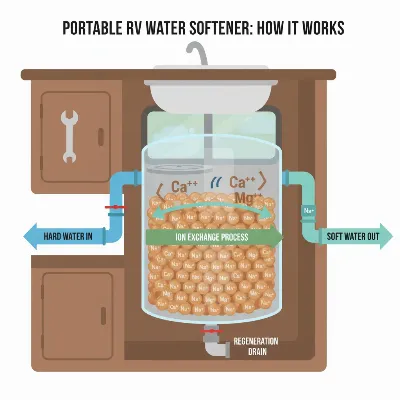 Illustration of ion exchange process in a portable water softener for mobile homes
Types of Portable Water Softeners for Mobile Living
When considering a portable water softener for your mobile home, you’ll encounter primarily two main types, each with distinct advantages and operating principles: salt-based (ion exchange) and salt-free (conditioners).
Salt-Based (Ion Exchange) Portable Water Softeners
These are the most common and effective type of portable water softeners, operating on the ion exchange principle. They actively remove calcium and magnesium from the water, truly “softening” it.
- Mechanism: Water passes through a tank containing resin beads charged with sodium ions. Hardness minerals (calcium and magnesium) in the water are attracted to the resin and exchanged for sodium ions.
- Advantages: Delivers genuinely soft water, which means better lathering of soaps, no mineral buildup, and improved skin and hair feel. They are highly effective at treating very hard water. Regeneration is typically simple, often requiring common table salt.
- Disadvantages: Requires regeneration with salt periodically, which can involve a manual process and produces a small amount of wastewater during the brine flush. You’ll need to monitor and refill salt levels.
Salt-Free (Conditioner) Portable Water Softeners
Unlike salt-based systems, salt-free conditioners do not remove hard water minerals. Instead, they change the structure of these minerals so they are less likely to stick to surfaces and form scale.
- Mechanism: Technologies like Template Assisted Crystallization (TAC) convert hardness minerals into microscopic crystals that won’t adhere to pipes or appliances. Other salt-free options include magnetic or electronic descalers, which alter the electrical charge of minerals to prevent aggregation.
- Advantages: No salt required, meaning no need for salt refills and no wastewater discharge. They are generally very low maintenance and require no electricity. Environmentally friendly.
- Disadvantages: They “condition” the water, preventing scale, but do not truly “soften” it. You may not experience the same silky feel on skin or the enhanced lathering of soaps that you get with salt-based softeners. Less effective for extremely hard water.
Comparison Table: Salt-Based vs. Salt-Free Portable Water Softeners
| Feature | Salt-Based (Ion Exchange) | Salt-Free (Conditioner) |
|---|---|---|
| Mechanism | Removes hardness minerals (ion exchange) | Changes mineral structure (e.g., TAC, magnetic) |
| Effect | True soft water, prevents scale | Prevents scale, does not truly soften |
| Salt Use | Required for regeneration | Not required |
| Maintenance | Regular salt refills, manual regeneration | Minimal, no salt refills |
| Water Waste | Small amount during regeneration | None |
| Electricity | Not typically required for portable models | Not typically required |
| Effectiveness | Highly effective for all hardness levels | Better for moderate hardness, prevents scale |
| Cost | Generally lower initial cost, ongoing salt expense | Higher initial cost, lower ongoing maintenance |
Top Portable Water Softeners for Mobile Homes 2026
The market for portable water softeners is robust, with several excellent options tailored for the unique needs of mobile home living. Here are some of the top contenders recognized for their performance, durability, and portability in 2026:
- On The Go Portable Water Softener (OTG4-DBLSOFT / OTG4-StdSoft): Often cited as an industry leader, the On The Go line offers robust performance in a compact package. The OTG4-DBLSOFT features a 16,000-grain capacity, delivering a significant amount of soft water (up to 1,600 gallons or 40 days of use for an RV) before regeneration is needed. It’s known for its sturdy construction, easy regeneration process (using common table salt), and compact dimensions. The standard model offers 8,000 grains, suitable for lighter use. Many users appreciate its made-in-USA assembly.
- VEVOR RV Water Softener: This unit has gained popularity for offering excellent value. With a 16,000-grain capacity, it provides substantial softening power at a more budget-friendly price point. It features food-grade recyclable resin, durable brass fittings, and a compact design. It’s an ideal choice for mobile homeowners looking for effective softening without breaking the bank.
- PRO+AQUA WS-P-16 Portable Water Softener: Designed for professional-grade performance on the go, the PRO+AQUA WS-P-16 boasts a 16,000-grain premium capacity. This system is known for producing more soft water than many competitors and includes NSF-certified food-grade resin. Its lightweight, compact size (10″ x 19.5″) and quick-connect fittings make it exceptionally travel-friendly, trusted by travelers and mobile homeowners alike.
- US Water Escort High Capacity Portable Water Softener: Specifically designed for applications where permanent connections aren’t feasible, such as mobile homes, this unit excels at eliminating lime, hard water, and rust stains. It uses high-grade cation-exchange resin and offers easy regeneration in about an hour. It often comes with a 5-micron pre-filter, hardness test strips, and necessary adapters, making it a comprehensive solution.
- SoftCell Portable Water Softeners: SoftCell offers innovative, high-capacity systems perfect for mobile homes. Users appreciate their easy-to-use and recharge design. Available in standard and tote models, these units focus on providing rust-free and spot-free surfaces, protecting your mobile home’s fixtures and enhancing cleaning routines.
These top models provide reliable performance, ensuring mobile homeowners can enjoy the benefits of soft water wherever their journey leads them.
Choosing the Right Portable Water Softener for Your Mobile Home
Selecting the ideal portable water softener involves more than just picking a popular model. It requires a thoughtful assessment of your specific needs, water conditions, and lifestyle.
First, assess your water hardness and daily water usage. You’ll need to know your water’s grain per gallon (GPG) measurement. You can often get this from local water reports or by using simple test strips included with many softeners or available separately. Multiply your household’s daily water usage (an average person uses about 75 gallons per day) by your water hardness in GPG to determine your daily grain requirement. This calculation will guide you toward the appropriate grain capacity for your softener. Portable units typically range from 8,000 to 16,000 grains, with higher capacities requiring less frequent regeneration.
> “Understanding your mobile home’s average daily water consumption and local water hardness is crucial. Don’t guess; accurate measurements ensure you choose a softener that truly meets your needs, preventing constant regeneration or insufficient softening.” – Alex Chen, Water Quality Specialist, RVWaterPro
Consider the size and portability of the unit. Mobile homes have limited space, so compact dimensions are key. Look for models that are lightweight, easy to carry, and designed with features like built-in handles and quick-connect fittings for hassle-free setup and breakdown.
Ease of regeneration is another significant factor. Most portable salt-based softeners require manual regeneration. Look for units with large mouth openings for easy salt addition and clear instructions. A quick regeneration time (often 15-30 minutes) is also a plus for busy travelers.
Finally, evaluate durability, warranty, and included accessories. A robust design capable of withstanding travel vibrations is essential. Check the warranty on the tank and resin. Useful accessories like connection hoses, hardness test strips, and storage caps can enhance the overall value and convenience of your investment. Balance these considerations with your budget and any potential long-term costs like salt consumption (for salt-based units) to make an informed decision.
Installation and Maintenance of Your Portable Water Softener
One of the great advantages of portable water softeners for mobile homes is their straightforward installation and relatively simple maintenance. You don’t need a plumbing expert; most units are designed for DIY setup.
Installation is typically a breeze:
- Placement: Choose a location that is easily accessible and provides stable ground for the unit, usually outside near your water source connection.
- Connections: Portable softeners usually feature standard garden hose connections. Connect the inlet side of the softener to your water source (e.g., campground spigot or fresh water tank pump) using a high-pressure drinking water hose.
- Outlet: Then, connect the outlet side of the softener to your mobile home’s main water inlet using another drinking water hose.
- Initial Flush: Before first use, it’s often recommended to flush the unit according to the manufacturer’s instructions to rinse any manufacturing residues.
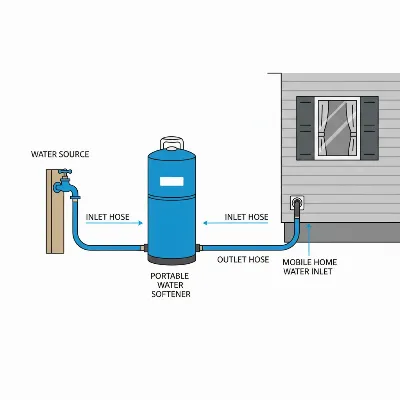 Diagram showing a portable water softener connected to a mobile home's water supply
Maintenance mainly involves regeneration:
- Regeneration Frequency: How often you regenerate depends on your water hardness and usage. Hardness test strips can help you determine when the water starts to feel hard again (typically below 3 GPG is soft).
- The Regeneration Process (for salt-based units): This usually involves disconnecting the unit (or using a bypass valve if available), adding a specified amount of common table salt (not water softener pellets) to the brine well or directly into the tank, and then flushing the unit with water. This brine solution recharges the resin beads. The process often takes 15-30 minutes.
- Backflushing: Some units recommend periodic backflushing, which involves reversing the water flow to clean the resin bed and prevent channeling. Instructions for this are usually provided in the user manual.
- Salt Levels: For salt-based units, consistently check your salt levels and refill as needed. Allowing the salt to run out will result in hard water returning.
- Storage: If storing the unit for an extended period, follow manufacturer guidelines for winterization or long-term storage to protect the resin.
It is crucial to refer to your specific model’s user manual for detailed installation and maintenance instructions to ensure optimal performance and longevity.
Where to Purchase Reliable Portable Water Softeners
Finding a reliable portable water softener for your mobile home is easier than ever, thanks to a variety of purchasing options available both online and in specialized stores.
Online Retailers: Large e-commerce platforms like Amazon, Walmart, and specialty RV/mobile home supply websites (e.g., RV Water Filter Store, Camping World) offer a wide selection of portable water softeners. Shopping online provides the convenience of browsing numerous brands and models, comparing prices, and reading extensive customer reviews. Look for sellers with clear return policies and good customer support.
Specialized Water Treatment Stores: Local or regional water treatment specialists might carry portable options, or at least be able to order them. These stores often provide expert advice tailored to your local water conditions, which can be invaluable. While less common for portable units, some hardware stores or home improvement centers may stock a limited selection.
RV and Camping Supply Stores: Given the overlap in needs, many stores catering to RVers and campers will have portable water softeners. These retailers understand the specific requirements for mobile living and can often offer units optimized for portability and outdoor use.
When purchasing, always prioritize reputable brands known for quality and customer service. Check for comprehensive warranties and assess the availability of customer support in case you encounter any issues. Reading user reviews and feedback from other mobile homeowners or RVers can also provide practical insights into a product’s real-world performance and durability.
Buying Guide: Essential Tips for Portable Water Softener Investment
Making an informed decision about a portable water softener is key to enjoying soft water in your mobile home for years to come. Here’s a concise buying guide to help you navigate your options:
- Determine Your Budget: Portable water softeners typically range from $150 to $400. Factor in not just the initial purchase price, but also ongoing costs like salt (for salt-based units) and potential replacement parts.
- Assess Water Hardness and Usage: Use test strips to measure your water’s grain per gallon (GPG). Calculate your daily water usage (number of occupants x 75 gallons) to determine the necessary grain capacity. A higher grain capacity means less frequent regeneration.
- Prioritize Portability: Look for compact, lightweight designs with built-in handles and quick-connect fittings. Units around 8″ to 10″ in diameter and 18″ to 22″ tall are common for easy storage and transport.
- Consider Regeneration Ease: For salt-based systems, choose models with large openings for simple salt addition and a quick, straightforward regeneration process.
- Review Warranty and Support: A good warranty (e.g., 2-5 years on components, lifetime on resin tank) signifies manufacturer confidence. Check for readily available customer support.
- Evaluate Brand Reputation: Stick with established brands known for quality and reliability in the water treatment industry.
- Check Included Accessories: Hoses, test strips, and storage caps can add value and convenience. Some units even include a pre-filter, which is a great bonus for protecting your softener from sediment.
- Salt-Based vs. Salt-Free: Understand the fundamental difference. If true softening for improved lather and feel is paramount, go salt-based. If minimal maintenance and no salt use are priorities, a salt-free conditioner might be suitable, acknowledging it prevents scale rather than removes hardness.
By focusing on these critical aspects, you can confidently select a portable water softener that seamlessly integrates into your mobile lifestyle, delivering the comfort and protection you deserve.
Conclusion
Embracing the convenience and comfort of soft water in your mobile home is a game-changer, eliminating the frustrating effects of hard water that can diminish your living experience and damage your investments. Portable water softeners offer a practical, efficient, and cost-effective solution, whether you’re battling scale buildup, dry skin, or stubborn soap scum. By understanding how these systems work, exploring the top models, and considering your specific needs, you can make an informed choice that enhances every aspect of your mobile living.
Protecting your appliances, improving your personal care, and simplifying your cleaning routines are just some of the profound benefits that a portable water softener brings to your mobile home. Are you ready to discover the difference soft water can make on your next adventure?
Câu Hỏi Thường Gặp
How much salt do portable water softeners typically use for regeneration?
Most portable salt-based water softeners, particularly 8,000 to 16,000 grain capacity units, typically use about 1-2 pounds (one standard box) of common table salt for each regeneration cycle. The exact amount and type of salt can vary slightly by model, so always check your specific unit’s manual for precise instructions.
Do portable water softeners require electricity?
The vast majority of portable water softeners, especially those designed for RVs and mobile homes, operate without electricity. They utilize the natural water pressure for the ion exchange process and manual regeneration. This makes them ideal for off-grid living or locations with limited power access.
How long does a portable water softener last?
With proper care and maintenance, the resin in a good quality portable water softener can last 5 to 10 years, and sometimes even longer. The unit’s tank and head assembly are often very durable, with some manufacturers offering lifetime warranties on the tank and extended warranties on other components, ensuring long-term reliability.
Can a portable water softener improve water pressure?
A portable water softener is designed to remove hardness minerals, not to improve water pressure. In fact, if not maintained or if the unit’s flow rate is too restrictive for your needs, it could slightly reduce pressure. However, a well-sized and properly functioning unit with sufficient flow capacity should not significantly impact your existing water pressure.
Is there a taste difference with softened water from a portable unit?
Yes, many users report a noticeable improvement in water taste and odor after using a portable water softener. By removing minerals that can contribute to a metallic or chalky taste, softened water often tastes cleaner and fresher. Some units might also include pre-filters to further enhance taste by reducing chlorine and sediment.
How often should I regenerate my portable water softener?
The regeneration frequency depends on your water’s hardness level and your daily water consumption. A typical 16,000-grain portable softener might need regeneration every 20-40 days for a couple using moderately hard water. Using hardness test strips and tracking your usage will help you determine the optimal schedule for your specific needs.
Can I use a portable water softener for drinking water?
Yes, water from a portable Water Softener is generally safe for drinking. The ion exchange process replaces hardness minerals with a small amount of sodium. If you are on a sodium-restricted diet, or prefer ultra-purified drinking water, you might consider adding a separate drinking water filter (like a reverse osmosis system) in conjunction with your softener.