For under $500, effective water softening solutions are available, primarily consisting of compact salt-based softeners for smaller households, salt-free conditioners for scale prevention, and electronic descalers for mild hardness. These budget-friendly options, such as the Morton M30 salt-based softener or the Aquasure Serene salt-free conditioner, offer viable ways to mitigate hard water issues without a significant financial investment. While premium features are limited, these systems provide essential functionality to protect appliances and improve water quality.
Water Softener: Solution for Hard Water
What is Hard Water? Effects of Hard Water
Hard water is a common issue affecting over 85% of homes across the United States. It’s characterized by a high concentration of dissolved minerals, primarily calcium and magnesium, which water picks up as it flows through mineral-rich soil and rock formations. While these minerals are generally not harmful to health, they can cause many problems throughout your home.
The detrimental effects of hard water are easily noticeable. You might observe a stubborn white, chalky residue—known as limescale—on faucets, showerheads, and inside kettles and coffee makers. This buildup can clog pipes, reduce water pressure, and significantly shorten the lifespan of water-using appliances like washing machines, dishwashers, and water heaters, often leading to increased energy consumption and higher utility bills. Beyond the visible damage, hard water can also affect your personal care; it reacts poorly with soap, making it difficult to form a rich lather, which can leave skin feeling dry and itchy, and hair dull or brittle. Clothes washed in hard water may also appear dingy or stiff over time.
What is a Water Softener? How Does it Work?
At its core, a “true” water softener is a whole-house system designed to remove the hardness-causing minerals from your water supply. The most common and effective type operates on the principle of ion exchange. Inside the softener’s mineral tank, there are thousands of tiny resin beads charged with sodium ions. As hard water flows through this tank, the positively charged calcium and magnesium ions—which are “harder” and have a stronger charge—are attracted to the resin beads, effectively displacing the sodium ions. The soft water, now rich in sodium (or potassium, if potassium chloride is used), then flows out to your home.
Over time, the resin beads become saturated with hard minerals and lose their softening capacity. This is where the regeneration process comes in. A brine solution, made from salt stored in a separate brine tank, is flushed through the resin bed. The concentrated sodium in the brine solution recharges the resin beads by forcing the hard mineral ions off and sending them down the drain as wastewater. This cycle ensures a continuous supply of soft water. The main components of a salt-based water softener typically include a mineral tank, a brine tank, and a control valve that manages the regeneration cycles.
It’s important to differentiate true water softeners from water conditioners or descalers, especially when considering budget options under $500. While true softeners remove hard minerals, conditioners and descalers alter the minerals’ properties to prevent them from adhering to surfaces and forming scale. Technologies like Template Assisted Crystallization (TAC), magnetic, or electronic descalers fall into this category. They offer a salt-free, low-maintenance alternative, but they do not actually soften the water or provide the same lathering benefits as a salt-based system. Many affordable solutions within the $500 range are often these types of conditioners or smaller capacity salt-based systems designed for specific needs or less severe hardness.
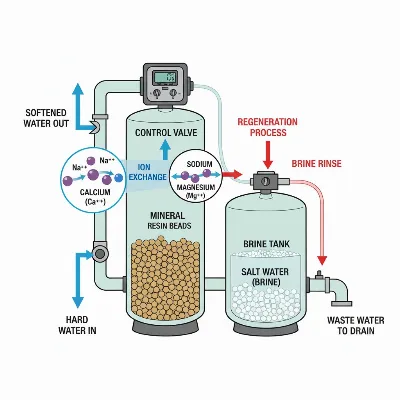 Illustration of how a salt-based water softener works with ion exchange resin beads
Common Types of Water Softeners on the Market
|
Our Picks for the Best Water Softener in 2026
As an Amazon Associate I earn from qualifying purchases.
|
||
| Num | Product | Action |
|---|---|---|
| 1 | Electronic Water Descaler System for Whole House, Salt-Free Water Softener - Compatible with Most Pipes, Prevents Limescale Build-Up, Easy Install & Maintenance-Free |

|
| 2 | H&G Lifestyles Whole House Water Softener 32,000 Grains, NSF certified Whole Home Water Filtration System for Well & City Water, Remove Calcium Magnesium, Food Grade Resin, Silver-Enhanced, 700,000 Gl |
|
| 3 | VEVOR RV Water Softener, 16,000 Grain Portable Water Softener, with 3/4" Brass Fittings and 42" Hose, Soften Hard Water Filter System for RVs, Trailers, Boats, Mobile Car Washing, Pressure Washing |
|
| 4 | RVGUARD 16,000 Grains Portable Water Softener for RV, Reduces Hardness & Minerals & Improve Water Quality, Protects Water Systems from Hard Water Damage |
|
| 5 | iSpring ED2000 Whole House Water Descaler, Alternative Electronic Salt-Free Hard Water Conditioner, Reduces Limescale Prevent Deposits Build-up, Different from a Water Softener |
|
| 6 | RV Water Softener with Water Hose, 16000 Grains 3/4" Brass Fittings Food-Grade Resin Soften Hard Water Improve Water Quality Portable Water Softener for RV, Trailers |
|
| 7 | PRO+AQUA 16,000 Grain Portable Water Softener for RV, Trailers, Boats, Mobile Car Wash, Pressure Wash – Protects Water Systems from Hard Water Damage and Corrosion, with Pre-Filled High-Capacity Resin |
|
| 8 | RV Water Softener System with Heavy Metal Filter & Protective Cover | 16,000 Grain Capacity | Removes Odors, Extends Resin Life 15% | Universal Fit for Motorhome, Camper, Travel Trailer |
|
| 9 | On The Go OTG4-VM-DBLSOFT Portable Compact Double Standard 16,000 Grain Water Softener with Drinking Water Safe Brass Fittings (NOT made in China, assembled by U.S. Workers in Indiana |
|
| 10 | Crystala Filters Portable RV Water Softener, 16,000 Grain with Stainless Steel Garden Hose Quick Connects for RVs, Trailers, Boats, Mobile Car Washing, Pressure Washing |
|
When exploring options within a budget, understanding the different types of water treatment systems available is crucial. Each type offers distinct benefits and limitations, especially concerning price and effectiveness.
Salt-Based (Ion Exchange) Water Softeners: These are the traditional and most effective systems for truly softening water. They remove calcium and magnesium ions through the ion exchange process described earlier.
- Pros: Highly effective at removing hard minerals, proven technology, provides “slippery” soft water that enhances soap lathering, extends appliance lifespan, and reduces cleaning efforts.
- Cons: Requires regular salt refills, generates wastewater during regeneration (brine discharge), adds a small amount of sodium to the water, and often has a higher upfront cost for whole-house systems (though some smaller or basic units can fall under $500).
Salt-Free Water Conditioners (Template Assisted Crystallization – TAC): These systems, often referred to as “descalers,” condition the water to prevent limescale buildup but do not actually remove the hardness minerals. They use a special media that causes hardness minerals to crystalize, preventing them from sticking to surfaces.
- Pros: No salt required, minimal maintenance, no wastewater or electricity needed, environmentally friendly, and retains beneficial minerals in the water.
- Cons: Does not truly “soften” the water (no slippery feel or enhanced lather), less effective for very hard water, and may still leave some spots on dishes. Entry-level whole-house TAC systems might just meet the $500 budget, while more robust options typically exceed it.
Electronic/Magnetic Water Descalers: These non-invasive devices attach to the outside of your pipes and use electromagnetic fields to alter the charge of mineral ions, preventing them from forming scale.
- Pros: Very affordable, easy DIY installation, no salt, no chemicals, no wastewater, and minimal space requirements.
- Cons: Limited effectiveness compared to salt-based softeners or TAC conditioners, primarily functions as a descaler rather than a softener, results can vary significantly depending on water conditions, and may not work for all types of hardness. Many options fall within the under-$500 category.
Portable Water Softeners: Designed for specific applications like RVs, boats, or small apartments, these compact salt-based units offer softening capabilities for intermittent or low-volume use.
- Pros: Highly portable, effective for specific needs, and generally very affordable.
- Cons: Low capacity, requires manual regeneration (often with table salt), not suitable for whole-house continuous use, and involves frequent maintenance. Several models are well under $500.
Comparison Table of Water Softeners
Choosing the right system means understanding the trade-offs at each price point, especially within a limited budget. Here’s a comparison of the types you’re likely to find under $500:
| Feature | Salt-Based Softener (Budget) | Salt-Free Conditioner (Budget) | Electronic Descaler (Budget) |
|---|---|---|---|
| Primary Function | Removes hardness minerals (Ca/Mg) | Prevents scale buildup | Prevents scale buildup |
| Water Feel | Truly “soft” and slippery | Unchanged (minerals still present) | Unchanged (minerals still present) |
| Effectiveness for Hardness | Moderate to Severe | Mild to Moderate | Mild |
| Salt Required | Yes, regular refills | No | No |
| Wastewater | Yes, during regeneration | No | No |
| Maintenance | Salt refills, periodic cleaning | Very low (media replacement if applicable) | None (check for function) |
| Installation | Moderate DIY, professional recommended | Moderate DIY | Easy DIY (external attachment) |
| Approx. Unit Cost (Under $500) | $300-$500 (lower capacity) | $330-$500 (entry-level) | $200-$400 |
| Typical Lifespan | 5-10 years | 5-10 years (media specific) | 5-10 years |
| Impact on Appliances | Extends lifespan, no scale | Extends lifespan, prevents scale | Reduces scale, some protection |
| Environmental | Brine discharge | Eco-friendly | Eco-friendly |
Top Water Softeners Under $500 Preferred Today
Finding a capable water softener for under $500 requires focusing on systems that deliver essential functionality without the premium bells and whistles. While whole-house, high-capacity salt-based systems typically exceed this budget, there are excellent options for apartments, smaller homes, or specific hard water challenges. Here are some of the top budget-friendly water treatment solutions.
Salt-Based Water Softeners: These provide true softening and are often compact or lower-capacity units.
- Morton M30: Priced around $450, the Morton M30 is a popular choice for its demand-initiated regeneration, which helps conserve salt. This compact unit is NSF-certified and delivers effective softening for smaller households or apartments, tackling moderate to severe hardness. Its user-friendly design makes it a solid value for those seeking genuine soft water.
- WaterBoss 220: Typically costing around $400, the WaterBoss 220 is known for its space-saving design and efficient performance. It features patented two-tank technology for effective salt-saving and regeneration, making it a good option for small to medium-sized households. The WaterBoss 220 is also NSF certified, assuring quality and performance in removing hardness minerals.
- A.O. Smith Softener: While specific models vary, some A.O. Smith units like the A.O. Smith AO-WH-SOFT-200 are sometimes found for around $399. These often cater to smaller homes and offer basic but reliable salt-based ion exchange. They are generally compact and designed for easy installation, providing a cost-effective entry into traditional water softening.
Salt-Free Water Conditioners/Descalers: These alternatives prevent scale buildup without using salt.
- Aquasure Serene Series (Salt-Free): Available for around $333, the Aquasure Serene offers a salt-free solution for scale prevention. This system uses Template Assisted Crystallization (TAC) technology to transform hardness minerals into a non-adhering crystalline form, protecting pipes and appliances without adding sodium to your water or requiring regeneration. It’s ideal for those with mild to moderate hard water who prefer a maintenance-free system.
- APEC FUTURA-15 Salt-Free Water Conditioner: Often found under $500, the APEC FUTURA-15 is another effective salt-free option that prevents limescale buildup. It’s designed for whole-house scale prevention, utilizing a physical process to condition water without chemicals or salt. This is a great choice for eco-conscious homeowners looking for appliance protection and improved water quality without traditional softening.
Electronic/Magnetic Water Descalers: These offer a low-cost, easy-to-install solution for scale reduction.
- Eddy Electronic Water Descaler: Typically ranging from $200-$300, the Eddy descaler is a popular electronic option. It’s incredibly easy to install, attaching to the outside of your main water pipe, and uses electromagnetic waves to prevent mineral buildup. While it doesn’t remove minerals, it can reduce hard water spots and prolong the life of appliances.
- YARNA Capacitive Electronic Water Descaler System (CWD24): Available for approximately $250-$350, the YARNA CWD24 is another well-regarded electronic descaler. Similar to the Eddy, it aims to prevent scale formation without salt or chemicals. It’s a convenient, low-cost solution for those looking for basic scale protection in moderately hard water conditions.
- iSpring ED2000 Whole-House Water Descaler System: This electronic descaler often falls under $300 and provides a similar function to the Eddy and YARNA. It aims to reduce scale buildup throughout the home, offering an affordable, maintenance-free alternative for homeowners seeking to mitigate hard water effects without undergoing a full ion exchange system.
Portable Water Softeners:
- On The Go Portable Water Softener: Priced around $272, this compact, salt-based unit is perfect for RVs, campers, or small, temporary setups. It offers true ion exchange softening in a portable format, requiring manual regeneration with table salt. It’s a specialized solution for travelers or those with very limited space.
These budget-friendly options demonstrate that effective hard water management is accessible. Each product targets different needs, from true ion exchange softening for smaller demands to salt-free alternatives focused purely on scale prevention.
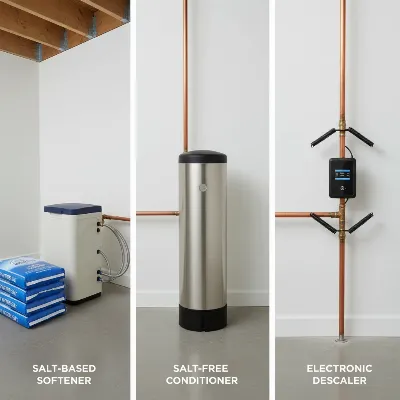 A collage or comparison image showing various budget water softener types: a compact salt-based unit, a salt-free conditioner tank, and a small electronic descaler attached to a pipe.
Guide to Choosing the Right Water Softener Under $500
Navigating the options for an affordable water softener means making smart choices that align with your specific circumstances. Here’s a practical guide to help you select the best budget-friendly system.
-
Assess Your Water Hardness Level: This is the most critical first step. You can purchase a home water test kit online or from a hardware store, or contact your local water utility for a water quality report. Knowing your grain per gallon (GPG) hardness will determine if a salt-based softener, salt-free conditioner, or electronic descaler is appropriate. For very high hardness (above 15 GPG), a salt-based system is generally more effective. For mild to moderate hardness (under 10-15 GPG), a salt-free conditioner or even an electronic descaler might suffice for scale prevention.
-
Determine Your Household’s Water Usage: While budget systems have limitations, it’s still important to estimate your daily water consumption. Multiply the number of people in your household by 75 gallons (average daily use per person) to get a rough estimate. This helps determine the grain capacity needed for salt-based softeners. However, for systems under $500, expect lower capacities (e.g., 24,000 to 32,000 grains), which are generally suitable for 1-3 person households or smaller homes.
-
Understand the Difference Between Softening and Conditioning: Be clear about your primary goal. Do you want truly soft water that lathers well and feels slick, or are you mainly concerned with preventing limescale buildup on fixtures and appliances? Salt-based units remove minerals, providing true softening. Salt-free conditioners and electronic descalers manage minerals to prevent scale but don’t produce physically “soft” water. Your budget often dictates which of these functionalities is more accessible.
-
Consider Installation and Long-Term Costs: Many budget systems are designed with DIY installation in mind, which can save you $1,000-$3,000 compared to professional plumbing. However, ensure you’re comfortable with basic plumbing tasks. For salt-based units, factor in the ongoing cost of salt (typically $100-$500 annually). Salt-free and electronic systems have minimal to no ongoing consumable costs, making them appealing for long-term savings.
-
Look for Certifications and Warranties: For any water treatment product, NSF/ANSI certifications (like NSF/ANSI Standard 44 for salt-based softeners or Standard 61 for components) indicate that the system has been tested and meets specific performance and safety standards. Even budget models should offer a reasonable warranty on components, providing peace of mind.
-
Read User Reviews: Customer feedback can offer invaluable insights into a system’s real-world performance, ease of installation, and long-term reliability. Pay attention to reviews from users with similar water hardness levels and household sizes.
Water Softener Installation and Usage Guide
Installing a water softener, especially many of the compact, budget-friendly models, can often be a manageable DIY project. This approach can significantly reduce the overall cost of ownership. However, for those uncomfortable with plumbing, professional installation is always an option, though it will push the total cost above the $500 mark.
Basic Installation Steps (General Overview): Most whole-house water softeners are installed on the main water line where water enters your home, after the main shut-off valve and before the water heater.
- Shut off the main water supply and drain the pipes.
- Cut into the main water line to install a bypass valve (highly recommended for maintenance).
- Connect the inlet and outlet ports of the softener to the bypass valve.
- For salt-based systems, connect a drain line from the control valve to a suitable drain (e.g., utility sink, standpipe, floor drain) for regeneration wastewater. Also, connect the brine line from the brine tank to the control head.
- For electronic descalers, simply wrap the coils around your main water pipe and plug the unit into an electrical outlet. No plumbing is required.
- Once connections are secure, slowly open the main water supply and check for leaks.
- Program the control head (for salt-based units) according to the manufacturer’s instructions.
Usage and Maintenance:
- Salt-Based Softeners:
- Salt Refills: Regularly check the salt level in the brine tank (typically monthly). Keep the tank at least one-quarter full, and ideally no more than two-thirds full, to allow space for proper brine formation. Use high-quality water softener salt (pellets or cubes) to prevent bridging.
- Brine Tank Cleaning: Periodically clean the brine tank, usually once a year, to remove any sediment or salt mush that can build up at the bottom.
- Resin Cleaning: Some manufacturers recommend a resin cleaner annually to maintain efficiency, especially if you have iron in your water.
- Salt-Free Conditioners: These generally require very little maintenance. Some systems might have a pre-filter that needs regular cleaning or replacement, and the conditioning media itself may have a lifespan (e.g., 3-5 years) after which it needs to be replaced.
- Electronic Descalers: Virtually maintenance-free. Ensure the unit remains plugged in and its indicator lights confirm operation.
Safety Considerations: Always follow the manufacturer’s installation and operating instructions meticulously. Ensure proper electrical connections if applicable, and if you are unsure about any step, consult with a licensed plumber.
Where to Buy Water Softeners Under $500 Reputably?
Finding reliable and affordable water softeners requires knowing where to look. While specialized water treatment stores might carry higher-end models, several reputable retailers offer budget-friendly options, especially online.
Online Retailers:
- Amazon: Offers a wide selection of electronic descalers, portable softeners, and some smaller capacity salt-based systems from various brands. It’s a good place to find competitive pricing and numerous customer reviews.
- Home Depot & Lowe’s: These large home improvement chains carry a range of water softeners, including models from brands like Morton, WaterBoss, and A.O. Smith, many of which can fall within the under-$500 category. Their websites often have a broader selection than in-store.
- Manufacturer Websites: Buying directly from brands like Aquasure, Eddy, or YARNA can sometimes offer specific models or bundles that fit your budget, along with direct manufacturer support and warranties.
- Specialty Online Water Treatment Stores: Websites focusing solely on water filtration might occasionally have sales or clearance items that bring higher-quality budget models into your price range.
When purchasing online, always verify the seller’s reputation, check the return policy, and confirm that the warranty is valid.
Buying Guide: Important Notes When Buying a Water Softener Under $500
Navigating the budget market for water softeners requires a keen eye and realistic expectations. Here are critical points to consider before making your purchase.
-
Manage Expectations: A system under $500 will not typically offer the same advanced features, high capacity, or durability as a premium unit costing several times more. Understand that you are investing in an entry-level solution, which may require more frequent maintenance or be better suited for smaller households and moderate hardness levels. Don’t expect a whole-house, high-grain capacity salt-based softener that lasts 15-20 years for this price.
-
Prioritize Essential Features: In this budget, focus on systems that offer core functionality. For salt-based units, look for demand-initiated regeneration (metered systems) over time-based regeneration, as this significantly saves on salt and water. For salt-free options, verify the technology (e.g., TAC) and its suitability for your water hardness.
-
Brand Reputation and Support: Even within the budget category, choose brands known for their reliability and customer support. Companies like Morton, WaterBoss, A.O. Smith, Aquasure, and Eddy have established reputations. A good warranty, especially on the tank and valve, is a strong indicator of manufacturer confidence.
-
Understand Total Cost of Ownership: The initial purchase price is just one part of the equation. For salt-based softeners, factor in ongoing salt costs. For salt-free systems with media, consider eventual media replacement costs. Electronic descalers are typically the lowest in terms of running costs. potential DIY installation savings versus professional fees.
-
Read the Fine Print: Pay close attention to product specifications, particularly grain capacity (for salt-based), flow rates, and specific limitations regarding water hardness levels. Some budget conditioners might struggle with very high levels of hardness or iron.
> “While the allure of a sub-$500 water softener is strong, it’s essential to manage expectations. Many systems in this range are excellent for scale prevention or for smaller households with moderate hard water, but they may not offer the same robust softening power as premium, higher-capacity ion exchange units.” – Admin of Reviewcopia.com, Water Treatment Specialist
Conclusion
Tackling hard water in your home doesn’t have to be an overwhelming financial burden. While systems under $500 come with certain limitations, they offer viable solutions for many homeowners. By carefully assessing your water hardness, understanding the differences between true softeners and conditioners, and choosing a system that aligns with your household’s needs and your budget, you can significantly improve your water quality. Whether it’s a compact salt-based softener, an efficient salt-free conditioner, or an easy-to-install electronic descaler, a budget-friendly option exists to protect your appliances, enhance your comfort, and reduce the chores associated with hard water.
Are you ready to enjoy the benefits of better water without breaking the bank?
Frequently Asked Questions
Are budget water softeners effective for very hard water?
Budget water softeners, especially those under $500, are generally most effective for mild to moderate hard water. While some compact salt-based units can handle moderate to severe hardness in smaller households, high-grain capacity systems for very hard water typically exceed this price point. Salt-free conditioners and electronic descalers in this range are primarily for scale prevention, not for truly softening very hard water.
What is the difference between a water softener and a water descaler/conditioner?
A traditional water softener (salt-based) uses an ion exchange process to physically remove hardness minerals (calcium and magnesium) from the water, resulting in truly “soft” water. A water descaler or conditioner, such as those using Template Assisted Crystallization (TAC) or electronic fields, alters the minerals to prevent them from forming scale, but does not remove them or change the water’s feel.
How much does it cost to maintain a budget water softener?
Maintenance costs for budget water softeners vary by type. Salt-based units require regular salt refills, which typically cost between $100-$500 annually, depending on water hardness and household usage. Salt-free conditioners may require occasional media or pre-filter replacements every few years. Electronic descalers are virtually maintenance-free, with negligible running costs.
Can I install a budget water softener myself?
Many budget-friendly water softeners, particularly compact salt-based units, salt-free conditioners, and electronic descalers, are designed for DIY installation. This can save you hundreds to thousands of dollars in professional plumbing fees. However, basic plumbing knowledge and tools are usually required for systems connecting to your main water line. Electronic descalers are the easiest, as they simply attach to the outside of your pipes.
What grain capacity should I look for in a budget water softener?
For salt-based water softeners under $500, you will typically find units with a grain capacity between 24,000 to 32,000 grains. This capacity is generally suitable for 1-3 person households or smaller homes with mild to moderate hard water. Always match the grain capacity to your household’s estimated daily water usage and hardness level for optimal performance.
Get our weekly buyer guide
Practical specs, not advice. Unsubscribe anytime.

I went with an electronic descaler for my mild hard water issues, and it’s definitely made a difference. My skin feels less dry after showering, and I’ve noticed less spotting on my glasses. It’s not a dramatic change like a full salt-based system, but for the price and ease, I’m happy with it.
I was really skeptical about finding a good water softener for under $500, but the Morton M30 has been a game changer. Our old dishwasher was constantly getting scale buildup, and now everything comes out sparkling. It was pretty easy to install too, which was a huge plus for us.
We live in an area with really hard water, and I was tired of replacing appliances every few years. This post helped me realize I could get a compact salt-based softener without breaking the bank. Our coffee maker and water heater are definitely thanking me, and our clothes feel softer too.
The Aquasure Serene salt-free conditioner was appealing because I didn’t want to deal with salt, but I’m not sure it’s completely solved our scale problem. There’s definitely less buildup in the shower, but I still see some on our faucets. It’s better than nothing, but I was hoping for a bit more.