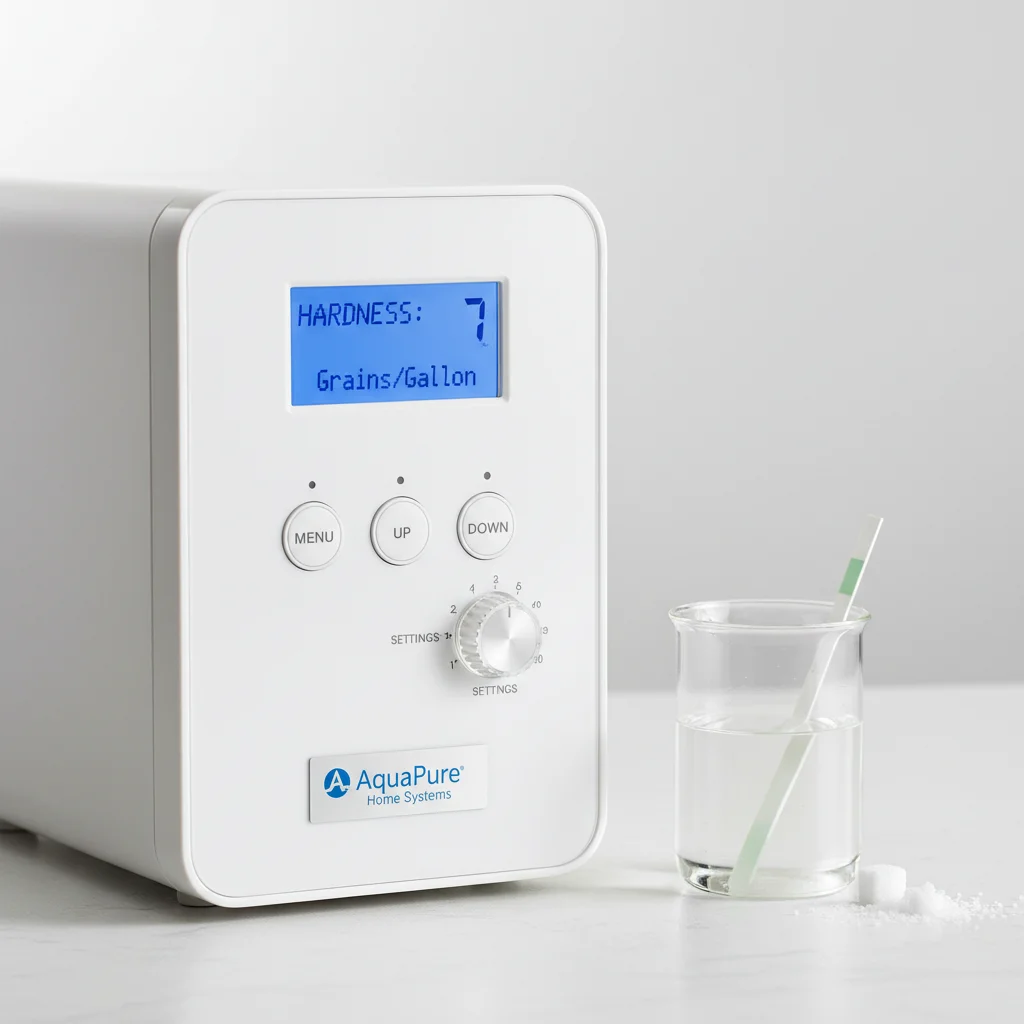
Setting your water softener to the ideal hardness level is crucial for efficient operation and optimal water quality. For most households, the recommended hardness setting ranges between 3 to 5 grains per gallon (GPG). This range effectively prevents scale buildup and soap scum without making the water feel overly slick or soft. Understanding your specific water hardness and adjusting your system accordingly ensures you get the best performance and extend the life of your appliances.
Understanding Your Water Hardness
Before adjusting your water softener settings, you need to know your home’s raw water hardness. This can be determined using a home test kit, contacting your local water utility, or having a professional test performed. Water hardness is typically measured in grains per gallon (GPG) or parts per million (PPM). One GPG is equivalent to 17.1 PPM. Knowing this baseline is essential for programming your softener accurately. For shop curated home water on this site.
Calculating Your Ideal Softener Setting
Once you have your raw water hardness, you can calculate the ideal setting for your water softener. Most softeners require you to input the hardness in GPG. If your water is very hard, say 15 GPG, setting your softener to reduce it to 3-5 GPG will provide significant benefits. Some people prefer slightly softer water, while others find anything below 3 GPG to feel too slick. Experiment within the 3-5 GPG range to find what feels best for your household.
Adjusting Your Water Softener Controls
|
Our Picks for the Best Water Softener in 2026
As an Amazon Associate I earn from qualifying purchases.
|
||
| Num | Product | Action |
|---|---|---|
| 1 | H&G Lifestyles Whole House Water Softener 32,000 Grains, NSF certified Whole Home Water Filtration System for Well & City Water, Remove Calcium Magnesium, Food Grade Resin, Silver-Enhanced, 700,000 Gl |

|
| 2 | Electronic Water Descaler System for Whole House, Salt-Free Water Softener - Compatible with Most Pipes, Prevents Limescale Build-Up, Easy Install & Maintenance-Free |
|
| 3 | RV Water Softener with Water Hose, 16000 Grains 3/4" Brass Fittings Food-Grade Resin Soften Hard Water Improve Water Quality Portable Water Softener for RV, Trailers |
|
| 4 | On The Go OTG4-VM-DBLSOFT Portable Compact Double Standard 16,000 Grain Water Softener with Drinking Water Safe Brass Fittings (NOT made in China, assembled by U.S. Workers in Indiana |
|
| 5 | Crystala Filters Portable RV Water Softener, 16,000 Grain with Stainless Steel Garden Hose Quick Connects for RVs, Trailers, Boats, Mobile Car Washing, Pressure Washing |
|
| 6 | VEVOR RV Water Softener, 16,000 Grain Portable Water Softener, with 3/4" Brass Fittings and 42" Hose, Soften Hard Water Filter System for RVs, Trailers, Boats, Mobile Car Washing, Pressure Washing |
|
| 7 | iSpring ED2000 Whole House Water Descaler, Alternative Electronic Salt-Free Hard Water Conditioner, Reduces Limescale Prevent Deposits Build-up, Different from a Water Softener |
|
| 8 | RVGUARD 16,000 Grains Portable Water Softener for RV, Reduces Hardness & Minerals & Improve Water Quality, Protects Water Systems from Hard Water Damage |
|
| 9 | RV Water Softener System with Heavy Metal Filter & Protective Cover | 16,000 Grain Capacity | Removes Odors, Extends Resin Life 15% | Universal Fit for Motorhome, Camper, Travel Trailer |
|
| 10 | PRO+AQUA 16,000 Grain Portable Water Softener for RV, Trailers, Boats, Mobile Car Wash, Pressure Wash – Protects Water Systems from Hard Water Damage and Corrosion, with Pre-Filled High-Capacity Resin |
|
The method for adjusting your water softener settings varies by model. Most modern softeners feature a digital control panel where you can input the water hardness. Consult your owner’s manual for specific instructions. Typically, you’ll navigate to a ‘settings’ or ‘program’ menu and locate the ‘water hardness’ or ‘grains per gallon’ option. Input your desired GPG, usually within the 3-5 GPG range, and save the changes. It may take a few regeneration cycles for the new settings to fully take effect.
Factors Influencing Optimal Settings
Several factors can influence the optimal water softener settings for your home. These include the number of people in your household, your daily water usage, and the types of appliances you have. A larger family with higher water consumption might benefit from a slightly lower GPG setting to ensure consistent soft water. Conversely, if you have very sensitive skin, you might prefer water on the softer side of the recommended range. Consider these variables when fine-tuning your system.
- Number of occupants in the home
- Average daily water consumption
- Presence of high-water-use appliances (e.g., dishwashers, washing machines)
- Personal preference for water feel
- Specific water quality issues beyond hardness
Monitoring and Maintenance After Adjustment
After adjusting your water softener settings, it’s important to monitor your water quality. You can use a simple home test kit to periodically check the softened water’s hardness. If you notice scale buildup returning or your water still feels too hard, you may need to slightly decrease the GPG setting. Conversely, if the water feels excessively slick, you might increase it. Regular maintenance, such as adding salt and cleaning the brine tank, also plays a critical role in maintaining optimal performance.For more advanced systems, consider professional calibration.
Get our weekly buyer guide
Practical specs, not advice. Unsubscribe anytime.
