For large homes, a high capacity water softener is a crucial solution to combat hard water issues, typically defined by systems with 40,000 to 100,000 grains capacity and a flow rate of at least 15 GPM (gallons per minute). These systems effectively remove dissolved minerals like calcium and magnesium, which cause limescale buildup, dry skin, and reduced appliance efficiency. By selecting the correct size based on water hardness and daily usage, large households can ensure a continuous supply of soft water, protecting plumbing and improving overall water quality.
Water Softener: The Solution for Hard Water
What is Hard Water? The Impact of Mineral Buildup
Hard water is characterized by high concentrations of dissolved minerals, primarily calcium and magnesium. These minerals are picked up by water as it travels through the ground, affecting homes in many regions. The levels are measured in grains per gallon (GPG) or parts per million (PPM), with anything above 7 GPG generally considered hard.
The presence of hard water can lead to a host of problems that impact daily life and household expenses. Health-wise, hard water can strip natural oils from skin and hair, leaving them dry, irritated, and brittle. For your home, the effects are far-reaching: limescale buildup clogs pipes, reduces water pressure, and significantly decreases the efficiency and lifespan of water-fed appliances like water heaters, dishwashers, and washing machines. You’ll also notice soap scum on dishes, cloudy glassware, and stiff, faded laundry, requiring more soap and detergent to achieve cleanliness. Identifying hard water might involve noticing white, crusty deposits on faucets and showerheads, a film on shower doors, or a chalky taste in your drinking water. For browse all home water articles on this site.
What is a Water Softener? How Ion Exchange Works
A water softener is a system designed to remove these hardness-causing minerals from your water supply. The most common and effective type is the salt-based ion exchange water softener. This system works by passing hard water through a resin tank filled with negatively charged resin beads, which are preloaded with positively charged sodium (or potassium) ions. As calcium and magnesium ions—which carry a stronger positive charge—flow through the tank, they bind to the resin beads, effectively “exchanging” places with the sodium ions. This process removes the hardness minerals, delivering softened water to your home.
The main components of a typical salt-based water softener include a mineral tank (containing the resin beads), a brine tank (for holding salt and creating a saltwater solution), and a control valve (which manages the flow of water and initiates the regeneration cycle). Over time, the resin beads become saturated with hardness minerals and need to be “recharged” or “regenerated.” During regeneration, the control valve flushes the resin with the saltwater brine from the brine tank. The concentrated salt solution forces the calcium and magnesium ions off the resin beads, and this mineral-rich wastewater is then discharged, usually into a drain. The resin beads are then ready to continue softening water.
Choosing the Right High Capacity Water Softener for Large Homes
Selecting the correct water softener size and type is crucial for large households, typically those with five or more residents and high daily water consumption, often exceeding 300-400 gallons. An undersized unit will frequently run out of soft water, decrease water pressure, and require excessive regeneration, while an oversized one can lead to inefficient operation and wasted resources.
High capacity water softeners are generally defined by their grain capacity, ranging from 40,000 to 100,000 grains, and a flow rate of at least 15 GPM (gallons per minute). These specifications ensure they can handle the substantial daily demands without constant regeneration, providing consistent soft water even during peak usage.
Understanding Your Household’s Needs
|
Our Picks for the Best Water Softener in 2026
As an Amazon Associate I earn from qualifying purchases.
|
||
| Num | Product | Action |
|---|---|---|
| 1 | RVGUARD 16,000 Grains Portable Water Softener for RV, Reduces Hardness & Minerals & Improve Water Quality, Protects Water Systems from Hard Water Damage |

|
| 2 | H&G Lifestyles Whole House Water Softener 32,000 Grains, NSF certified Whole Home Water Filtration System for Well & City Water, Remove Calcium Magnesium, Food Grade Resin, Silver-Enhanced, 700,000 Gl |
|
| 3 | On The Go OTG4-VM-DBLSOFT Portable Compact Double Standard 16,000 Grain Water Softener with Drinking Water Safe Brass Fittings (NOT made in China, assembled by U.S. Workers in Indiana |
|
| 4 | Crystala Filters Portable RV Water Softener, 16,000 Grain with Stainless Steel Garden Hose Quick Connects for RVs, Trailers, Boats, Mobile Car Washing, Pressure Washing |
|
| 5 | Electronic Water Descaler System for Whole House, Salt-Free Water Softener - Compatible with Most Pipes, Prevents Limescale Build-Up, Easy Install & Maintenance-Free |
|
| 6 | VEVOR RV Water Softener, 16,000 Grain Portable Water Softener, with 3/4" Brass Fittings and 42" Hose, Soften Hard Water Filter System for RVs, Trailers, Boats, Mobile Car Washing, Pressure Washing |
|
| 7 | iSpring ED2000 Whole House Water Descaler, Alternative Electronic Salt-Free Hard Water Conditioner, Reduces Limescale Prevent Deposits Build-up, Different from a Water Softener |
|
| 8 | PRO+AQUA 16,000 Grain Portable Water Softener for RV, Trailers, Boats, Mobile Car Wash, Pressure Wash – Protects Water Systems from Hard Water Damage and Corrosion, with Pre-Filled High-Capacity Resin |
|
| 9 | RV Water Softener with Water Hose, 16000 Grains 3/4" Brass Fittings Food-Grade Resin Soften Hard Water Improve Water Quality Portable Water Softener for RV, Trailers |
|
| 10 | RV Water Softener System with Heavy Metal Filter & Protective Cover | 16,000 Grain Capacity | Removes Odors, Extends Resin Life 15% | Universal Fit for Motorhome, Camper, Travel Trailer |
|
To determine the ideal water softener capacity for your large home, you need to consider two primary factors: your water hardness level and your household’s daily water usage.
- Water Hardness Level: Obtain a water test kit or contact your local water provider to determine your water’s hardness in GPG. This measurement is critical, as harder water requires a higher capacity system.
- Daily Water Usage: A good rule of thumb is to multiply the number of people in your household by an average daily water consumption of 75-80 gallons per person. For a large family of 7, this could be around 525 gallons per day.
Once you have these figures, you can calculate your daily softening requirement: (Daily water usage in gallons) × (Water hardness in GPG) = Daily grain removal.
For example, if a family of seven uses 525 gallons daily and their water hardness is 10 GPG, their daily grain removal would be 5,250 grains (525 gallons x 10 GPG). To determine the appropriate softener capacity, multiply this daily requirement by the number of days you want between regeneration cycles (typically 7-10 days). So, 5,250 grains/day * 7 days = 36,750 grains. In this case, a 40,000 to 64,000-grain capacity system would be suitable, allowing for some reserve and less frequent regeneration. It’s often better to overestimate slightly to accommodate guests or increased water usage.
Salt-Based vs. Salt-Free Water Softeners: A Comparison
When exploring water softeners, you’ll primarily encounter two types: salt-based ion exchange systems and salt-free water conditioners.
- Salt-Based Water Softeners: These are the most prevalent and effective systems, utilizing ion exchange to physically remove calcium and magnesium ions and replace them with sodium ions. They offer true water softening, eliminating all the associated hard water problems.
- Salt-Free Water Conditioners: These systems, also known as descalers, do not remove hardness minerals. Instead, they typically use Template-Assisted Crystallization (TAC) technology to transform the minerals into harmless crystals that won’t stick to surfaces, thus preventing scale buildup. They are not true water softeners as the minerals remain in the water.
| Feature | Water Softener (Salt-Based) | Water Softener (Salt-Free / Conditioner) |
|---|---|---|
| Pros | – Most effective at removing hardness minerals | – No salt discharge, environmentally friendlier |
| – Eliminates scale, soap scum, dry skin/hair | – Low maintenance, no salt refills | |
| – Extends appliance lifespan, improves cleaning efficiency | – Minerals remain for health benefits | |
| – Provides true soft water experience | – No electricity required for some models | |
| Cons | – Adds minimal sodium to water (concern for low-sodium diets) | – Does not “soften” water, just prevents scale buildup |
| – Requires salt refills (monthly for large homes) | – Effectiveness debated for some technologies (magnetic) | |
| – Wastes some water during regeneration cycles | – Higher initial cost for many effective conditioners | |
| – Electrical hookup needed for control valve | – Filters may need regular replacement | |
| Costs | – Initial: $350-$500 (basic), $500-$7,000 (advanced) | – Initial: $1,000-$3,000+ |
| – Ongoing: Salt costs ($240/year average) | – Ongoing: Filter replacements | |
| Maintenance | – Monthly salt checks, yearly brine tank cleaning, resin replacement every 8-15 years | – Occasional filter changes |
Dual-Tank vs. Single-Tank Systems for High Water Usage
For large households with significant and often simultaneous water demands, the configuration of your water softener tanks can greatly impact your experience.
- Single-Tank Systems: These soften water until the resin capacity is reached, then initiate a regeneration cycle. During regeneration, the system temporarily supplies untreated hard water to your home. While more affordable and space-efficient, this can be inconvenient for large families who require a continuous supply of soft water, especially during peak usage times (e.g., multiple showers running simultaneously).
- Dual-Tank Systems: Featuring two resin tanks, these systems are designed to provide an uninterrupted supply of soft water. When one tank reaches capacity and enters its regeneration cycle, the other tank automatically takes over, ensuring that soft water is always available. This design is highly recommended for larger households, homes with high daily water demand, or families with unpredictable water usage patterns, despite the higher upfront investment.
“A water softener that is too small will frequently run out of soft water, reduce water pressure, require more service, and have a reduced service life. Oddly enough, a water softener that is too big can suffer from a different set of problems.” – PremierWater Technologies Minnesota, Water Treatment Experts.
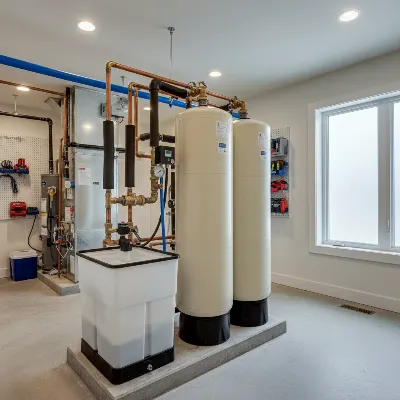 High capacity water softener system installed in a large home's utility room, showcasing dual tanks and plumbing connections.
Top High Capacity Water Softeners for Large Homes
Several brands and models stand out for their performance, capacity, and reliability in larger households. When considering options, look for features like demand-initiated regeneration, high flow rates (15+ GPM), and durable resin beds.
- SpringWell SS: This system is highly praised for its impressive 20 GPM flow rate and 97.5% hardness reduction, ensuring no pressure drops even when multiple fixtures are in use.
- SoftPro Elite: Offering a massive grain capacity range (24,000 to 110,000 grains), the SoftPro Elite is suitable for extremely hard water conditions. Its upflow tank design can reduce salt consumption by up to 50%.
- Fleck 5600SXT: A popular choice for budget-conscious families, the Fleck 5600SXT provides reliable performance with metered (demand-initiated) regeneration, optimizing salt and water usage.
- GE GXSH40V 40,200 Grain Water Softener: This salt-based unit features SmartSoft technology that learns your household’s water usage patterns and adapts regeneration cycles accordingly. It offers easy electronic controls and a salt empty indicator.
- Whirlpool WHES44 44,000 Grain Capacity Water Softener: An affordable large-capacity option, it can remove up to 140 GPG hardness. It features a compact one-piece cabinet design with the resin tank housed inside the salt reservoir, saving space. It also includes an iron removal setting.
- AFWFilters Iron Pro 2 Combination Water Softener: Often recommended for large households, especially those dealing with both hard water and iron issues.
- Aquasana 1,000,000 Gallon Rhino (Salt-Free): While not a true softener, this system excels as a whole-house water filter combined with salt-free descaling. It offers multi-stage filtration, 97% chlorine removal, and a 10-year warranty, ideal for holistic water treatment.
- Pelican THD-PSE1800 Water Softener (Salt-Free): Another salt-free option that prevents scale using a catalytic process and includes a filtration system for chlorine. It offers a good flow rate of 15 GPM and is suitable for homes with up to six bathrooms.
Features to Look for in High Capacity Water Softeners
When investing in a high capacity water softener for your large home, consider these essential features to ensure optimal performance, efficiency, and longevity:
- Demand-Initiated Regeneration: This smart feature means the system only regenerates based on actual water usage, rather than a fixed timer. This significantly reduces salt and water waste, making your system more efficient and cost-effective.
- High Flow Rate (15+ GPM): A high flow rate is critical for large homes to maintain consistent water pressure across multiple bathrooms and appliances running simultaneously. Systems like the SpringWell SS (20 GPM) are excellent examples.
- Durable Resin Bed: The quality of the resin beads directly impacts the softener’s lifespan and efficiency. Look for systems with durable, high-quality resin beds that can last 8 to 15 years before needing replacement.
- Upflow Brining: Found in systems like the SoftPro Elite, upflow brining technology can reduce salt consumption by up to 50% and minimize backwashing, further enhancing efficiency.
- Warranty: A strong warranty on both the control valve and the tanks provides peace of mind and protection for your investment.
- Smart Technology: Some modern systems, like DROP, offer smart monitoring capabilities, allowing you to track performance and receive alerts remotely via an app.
Installation and Maintenance for High-Volume Systems
Installing a high-volume water softener is a significant home improvement that often requires professional expertise. While DIY installation is possible for those with plumbing skills, professional installation ensures correct setup according to local codes and often preserves manufacturer warranties. Systems like the SpringWell SS can take approximately four hours to install due to their complex connections.
Once installed, regular maintenance is key to maximizing the lifespan and efficiency of your high capacity system.
- Salt Refills: For salt-based systems, you’ll need to check the salt level in the brine tank monthly and typically add one 40-pound bag of water softener salt per month for an average large family. Ensure the salt level is at least 3-4 inches above the water level. Use only salt specifically designed for water softeners; table salt dissolves too quickly and can damage the system.
- Brine Tank Cleaning: Clean the brine tank annually to prevent salt bridging or sludge buildup, which can hinder regeneration.
- Resin Replacement: The resin beads will eventually degrade. For most durable systems, expect resin replacement every 8 to 15 years to maintain optimal softening performance.
- System Checks: Periodically inspect for leaks, unusual noises, or changes in water quality, and address any issues promptly.
Where to Purchase Reliable Water Softeners
When buying a high capacity water softener, it’s essential to choose a reputable vendor that offers quality products, good customer service, and reliable support.
- Online Retailers: Many top brands are available through major online platforms like Amazon, Lowe’s, and Home Depot, often with competitive pricing and delivery options. Websites specializing in water treatment, such as Quality Water Treatment, also offer a wide selection and expert advice.
- Local Plumbing & Water Treatment Dealers: These providers can offer personalized recommendations based on your local water quality, professional installation, and ongoing maintenance services. Brands like Culligan often work through authorized dealers.
- Big Box Stores: Retailers like Lowe’s and Home Depot carry popular brands such as Whirlpool and GE, offering a convenient way to purchase if you plan for DIY installation or have a local contractor.
Look for special promotions, extended warranties, and comprehensive customer support when making your purchase. Always verify the seller’s reputation and read customer reviews.
Buying Guide: Important Considerations
Navigating the world of water softeners can be complex, but keeping a few key points in mind will help you make the best decision for your large home:
- Budget: Consider both the initial purchase and installation costs, as well as ongoing operational expenses like salt or filter replacements. While salt-based systems generally have lower upfront costs, salt-free conditioners often have lower long-term maintenance needs.
- Brand Reputation & Supplier: Opt for reputable brands known for their durability and performance, like SpringWell, SoftPro, Fleck, GE, and Whirlpool. Purchase from authorized dealers or well-reviewed online retailers.
- Warranty & Support: A comprehensive warranty for the entire system, including the control valve and tanks, is crucial. Excellent after-sales support and readily available replacement parts are also vital.
- User Reviews: Insights from other users can provide valuable real-world perspectives on product performance, ease of installation, and customer service.
The goal is to balance quality, performance, and cost to find a system that effectively meets your household’s unique needs.
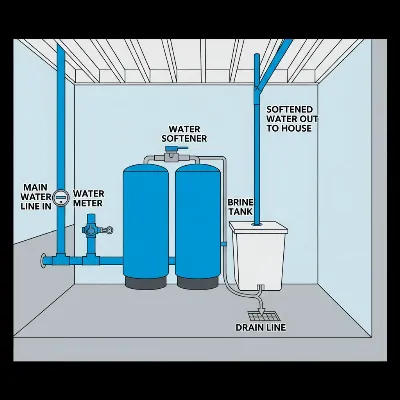 Diagram illustrating the basic installation of a whole-house water softener system into a home's main water line.
Conclusion
Choosing the best high capacity water softener for your large home is an investment that pays dividends in comfort, savings, and peace of mind. By accurately assessing your water hardness and daily consumption, understanding the differences between salt-based and salt-free systems, and prioritizing features like demand-initiated regeneration and high flow rates, you can select a system that delivers a continuous supply of luxurious soft water. With proper installation and routine maintenance, your water softener will protect your appliances, enhance your cleaning, and improve your everyday water experience for years to come.
Are you ready to say goodbye to hard water problems and embrace the benefits of softened water in your large home?
Frequently Asked Questions
Frequently Asked Questions
How many grains should a water softener for a family of 7 have?
For a family of seven using approximately 525 gallons of water daily, with average water hardness, a water softener with a 40,000 to 64,000 grain capacity is generally recommended. This capacity can handle around 3,500-4,500 grains of hardness per day, allowing for efficient regeneration cycles every 7-10 days.
Can a water softener also filter contaminants like chlorine?
While some water softeners might include basic sediment pre-filters, their primary function is to remove hardness minerals (calcium and magnesium). They are generally not effective at removing contaminants like chlorine, heavy metals (lead), or bacteria. For comprehensive water treatment, it's often necessary to combine a water softener with additional filtration systems, such as activated carbon filters or reverse osmosis.
How often do high capacity water softeners need salt?
High capacity salt-based water softeners in large homes typically require salt replenishment every 2 to 4 months. However, the exact frequency depends on your water's hardness, the number of residents, and your system's efficiency. It's advisable to check the salt level in your brine tank monthly and ensure it's always a few inches above the water level to maintain performance.
What are the main benefits of dual-tank water softeners for large households?
Dual-tank water softeners are highly beneficial for large households because they ensure a continuous supply of soft water, even when one tank is regenerating. This prevents interruptions in soft water availability, which is crucial for homes with high and simultaneous water demands, such as multiple family members showering or running appliances at the same time.
What is the typical flow rate for a high capacity water softener?
A high capacity water softener for a large home should have a flow rate of at least 15 GPM (gallons per minute). This ensures consistent water pressure across multiple fixtures and appliances running simultaneously, preventing noticeable drops in pressure during peak usage.
How long do resin beads last in a high capacity water softener?
The resin beads in a durable, high-quality high capacity water softener typically last between 8 to 15 years before needing replacement. Regular maintenance and proper regeneration cycles can help extend their lifespan and maintain optimal softening performance.
Choosing the Right High Capacity Water Softener
Determine the ideal water softener capacity for your large home by assessing water hardness and daily water usage.
Obtain a water test kit or contact your local water provider to determine your water's hardness in GPG (grains per gallon). This measurement is critical, as harder water requires a higher capacity system.
Multiply the number of people in your household by an average daily water consumption of 75-80 gallons per person. For example, a family of 7 might use around 525 gallons per day.
Multiply your daily water usage in gallons by your water hardness in GPG to find your daily grain removal requirement. For instance, 525 gallons x 10 GPG = 5,250 grains per day.
Multiply your daily grain removal by the desired number of days between regeneration cycles (typically 7-10 days). For example, 5,250 grains/day * 7 days = 36,750 grains. Choose a system with a capacity slightly higher than this, such as 40,000 to 64,000 grains, to allow for reserve and less frequent regeneration.
Get our weekly buyer guide
Practical specs, not advice. Unsubscribe anytime.

We finally pulled the trigger on a high capacity system after dealing with hard water for years in our large home. The difference is incredible! No more limescale buildup on our showerheads and the dishes actually come out clean from the dishwasher. It’s definitely worth the investment for anyone with a big family and high water usage.
We got a system with a 15 GPM flow rate, and while the water quality is much better, I’ve noticed a slight drop in water pressure when multiple showers are running at once. It’s not a dealbreaker, but it’s something to consider if you have a really large household with simultaneous high demand. Otherwise, the soft water is a huge improvement for our appliances.
I was skeptical about how much a water softener could help my dry skin, but I’m genuinely impressed. My skin feels so much softer after showering, and I’ve noticed my hair is less brittle too. We went with a 60,000 grain capacity system, and it’s been perfect for our family of five. Installation was a bit of a hassle, but the results are great.
Our old water heater was constantly getting clogged with mineral buildup, and we were replacing appliances way too often. Since installing a high capacity softener, we haven’t had any issues. It’s such a relief to know our plumbing is protected and our appliances will last longer. This really is a crucial solution for hard water problems.