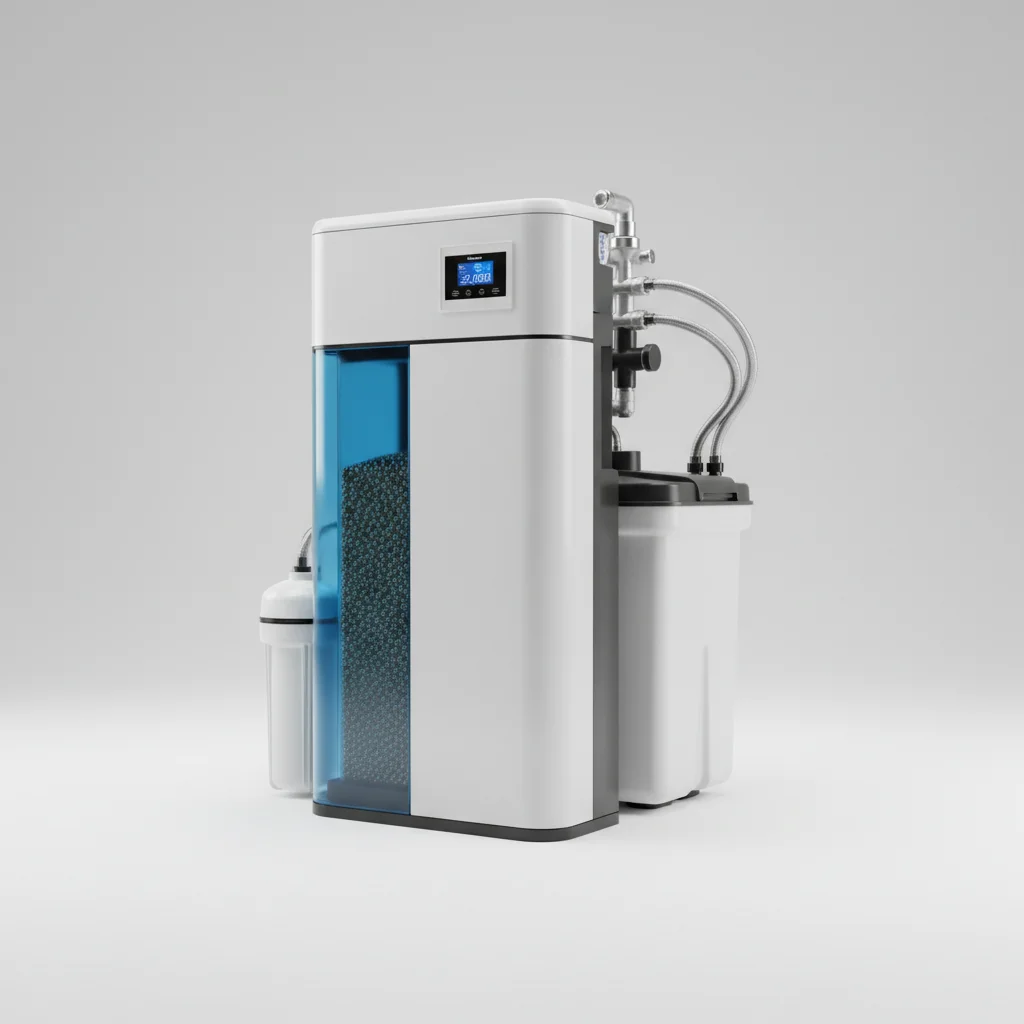
The ideal water softener capacity for a home typically ranges from 20,000 to 80,000 grains, depending on household size and water hardness. A properly sized unit ensures an adequate supply of softened water without excessive regeneration cycles, which saves both salt and water. For example, a family of four with 10 GPG hard water needs a system that can remove approximately 3,000 grains per day.
Understanding Grains and Water Hardness
Water hardness is measured in grains per gallon (GPG). To calculate your daily softening needs, multiply your household’s daily water usage (an average of 75 gallons per person) by the GPG of your water. This daily grain removal helps determine the appropriate capacity for your water softener. For shop curated home water on this site.
Most municipal water reports provide GPG information. If you have well water, a simple home test kit or professional water analysis can provide an accurate reading. Knowing your exact water hardness is the first step in selecting the right softener.
Calculating Your Household’s Daily Softening Needs
Once you know your water hardness and daily water usage, you can calculate your total daily grain removal requirement. This calculation is essential for choosing a water softener that can handle your demand without regenerating too frequently. Frequent regeneration wastes water and salt, while infrequent regeneration can lead to periods of hard water.
Consider factors like peak usage times and potential future increases in household size when making your calculations. It’s often better to slightly overestimate your needs to ensure consistent soft water.
Matching Capacity to Household Size
|
Our Picks for the Best Water Softener in 2026
As an Amazon Associate I earn from qualifying purchases.
|
||
| Num | Product | Action |
|---|---|---|
| 1 | On The Go OTG4-VM-DBLSOFT Portable Compact Double Standard 16,000 Grain Water Softener with Drinking Water Safe Brass Fittings (NOT made in China, assembled by U.S. Workers in Indiana |

|
| 2 | Electronic Water Descaler System for Whole House, Salt-Free Water Softener - Compatible with Most Pipes, Prevents Limescale Build-Up, Easy Install & Maintenance-Free |
|
| 3 | Crystala Filters Portable RV Water Softener, 16,000 Grain with Stainless Steel Garden Hose Quick Connects for RVs, Trailers, Boats, Mobile Car Washing, Pressure Washing |
|
| 4 | RVGUARD 16,000 Grains Portable Water Softener for RV, Reduces Hardness & Minerals & Improve Water Quality, Protects Water Systems from Hard Water Damage |
|
| 5 | PRO+AQUA 16,000 Grain Portable Water Softener for RV, Trailers, Boats, Mobile Car Wash, Pressure Wash – Protects Water Systems from Hard Water Damage and Corrosion, with Pre-Filled High-Capacity Resin |
|
| 6 | VEVOR RV Water Softener, 16,000 Grain Portable Water Softener, with 3/4" Brass Fittings and 42" Hose, Soften Hard Water Filter System for RVs, Trailers, Boats, Mobile Car Washing, Pressure Washing |
|
| 7 | iSpring ED2000 Whole House Water Descaler, Alternative Electronic Salt-Free Hard Water Conditioner, Reduces Limescale Prevent Deposits Build-up, Different from a Water Softener |
|
| 8 | RV Water Softener with Water Hose, 16000 Grains 3/4" Brass Fittings Food-Grade Resin Soften Hard Water Improve Water Quality Portable Water Softener for RV, Trailers |
|
| 9 | H&G Lifestyles Whole House Water Softener 32,000 Grains, NSF certified Whole Home Water Filtration System for Well & City Water, Remove Calcium Magnesium, Food Grade Resin, Silver-Enhanced, 700,000 Gl |
|
| 10 | RV Water Softener System with Heavy Metal Filter & Protective Cover | 16,000 Grain Capacity | Removes Odors, Extends Resin Life 15% | Universal Fit for Motorhome, Camper, Travel Trailer |
|
The number of people in your home significantly impacts the required water softener capacity. A single person or couple will have vastly different needs than a large family. Here’s a general guideline:
- 1-2 people: 20,000-30,000 grain capacity
- 3-4 people: 30,000-40,000 grain capacity
- 5-6 people: 40,000-50,000 grain capacity
- 7+ people or very hard water: 50,000-80,000+ grain capacity
These are estimates; always cross-reference with your specific water hardness. For instance, a small household with extremely hard water might need a higher capacity than a larger household with moderately hard water.
Regeneration Cycles and Efficiency
The frequency of regeneration cycles directly relates to your water softener’s capacity and your water usage. An optimally sized softener should regenerate every 3-7 days. If your softener is regenerating daily, it might be undersized, leading to increased salt and water consumption. Conversely, if it regenerates less often than every 7 days, it might be oversized, which isn’t necessarily bad but could mean you paid for more capacity than needed.
Modern water softeners often feature demand-initiated regeneration, which monitors water usage and only regenerates when necessary, improving efficiency.
Factors Beyond Grains: Flow Rate and Resin Quality
While grain capacity is paramount, also consider the flow rate (gallons per minute, GPM) of the water softener. This indicates how quickly the system can deliver softened water without a significant drop in water pressure. Ensure the flow rate meets your household’s peak demand, especially if you often use multiple water fixtures simultaneously.
The quality of the resin beads inside the softener also plays a role in its efficiency and longevity. High-quality, cross-linked resin can withstand more regeneration cycles and chlorine exposure, extending the life of your unit and maintaining its softening capabilities over time.
Frequently Asked Questions
What is the recommended water softener capacity for a family of four?
For a family of four, a water softener with a capacity between 30,000 and 40,000 grains is generally recommended. This range accounts for average daily water usage and moderate water hardness levels, ensuring efficient operation.
How do I calculate my home's daily water softening needs?
To calculate your daily softening needs, multiply your household's daily water usage (approximately 75 gallons per person) by your water's GPG (grains per gallon). For example, a family of four with 10 GPG hard water needs to remove about 3,000 grains daily.
How often should a water softener regenerate for optimal efficiency?
An optimally sized water softener should regenerate every 3 to 7 days. If it regenerates daily, it might be undersized, leading to increased salt and water consumption. Less frequent regeneration (beyond 7 days) suggests it might be oversized.
What factors besides grain capacity are important for a water softener?
Beyond grain capacity, consider the water softener's flow rate (gallons per minute or GPM) to ensure adequate water pressure during peak usage. The quality of the resin beads is also crucial for the system's efficiency and longevity, especially with chlorine exposure.
Where can I find my water's hardness level in GPG?
You can typically find your water's hardness level in GPG on your municipal water report. If you use well water, a home test kit or professional water analysis can provide an accurate reading of your specific water hardness.
Determine Your Home's Water Softener Capacity
Follow these steps to calculate the appropriate water softener capacity for your household, ensuring efficient operation and consistent soft water.
Obtain your water's hardness in GPG (grains per gallon). Check your municipal water report or use a home test kit for well water. This is the foundational number for all subsequent calculations.
Estimate your household's daily water usage. A general average is 75 gallons per person per day. Multiply this by the number of people in your household to get a total daily usage.
Multiply your total daily water usage by your water's GPG to find your total daily grain removal requirement. For instance, 300 gallons/day * 10 GPG = 3,000 grains/day.
Use the daily grain removal number and household size to match against general capacity guidelines. For 3-4 people, a 30,000-40,000 grain capacity is often suitable, but adjust for very hard water.
Get our weekly buyer guide
Practical specs, not advice. Unsubscribe anytime.

This really helped me understand the GPG measurement. Our municipal report showed 12 GPG, and with four people, we needed something substantial. We ended up getting a 60,000-grain system, and it’s been fantastic. The dishes are spotless, and our appliances seem to be running more efficiently. Great advice on sizing.
I was confused about what capacity we needed, especially with our well water. The suggestion to get a professional water analysis was key. Once we knew our exact GPG, choosing a system in the 50,000-grain range made a lot more sense. It’s been a huge improvement, though installation was a bit of a hassle.
We finally pulled the trigger on a new water softener after dealing with hard water for years. Based on the info here, we went with a 40,000-grain system for our family of three, and it’s been perfect. No more crusty buildup on the showerhead, and my skin feels so much better. Definitely worth the investment.
I appreciate the breakdown of how to calculate daily grain removal. I used the 75 gallons per person average, and it helped me narrow down options. My only complaint is that even with a 30,000-grain unit, I still feel like it regenerates a bit too often. Maybe my water is harder than I thought, or I underestimated our usage.